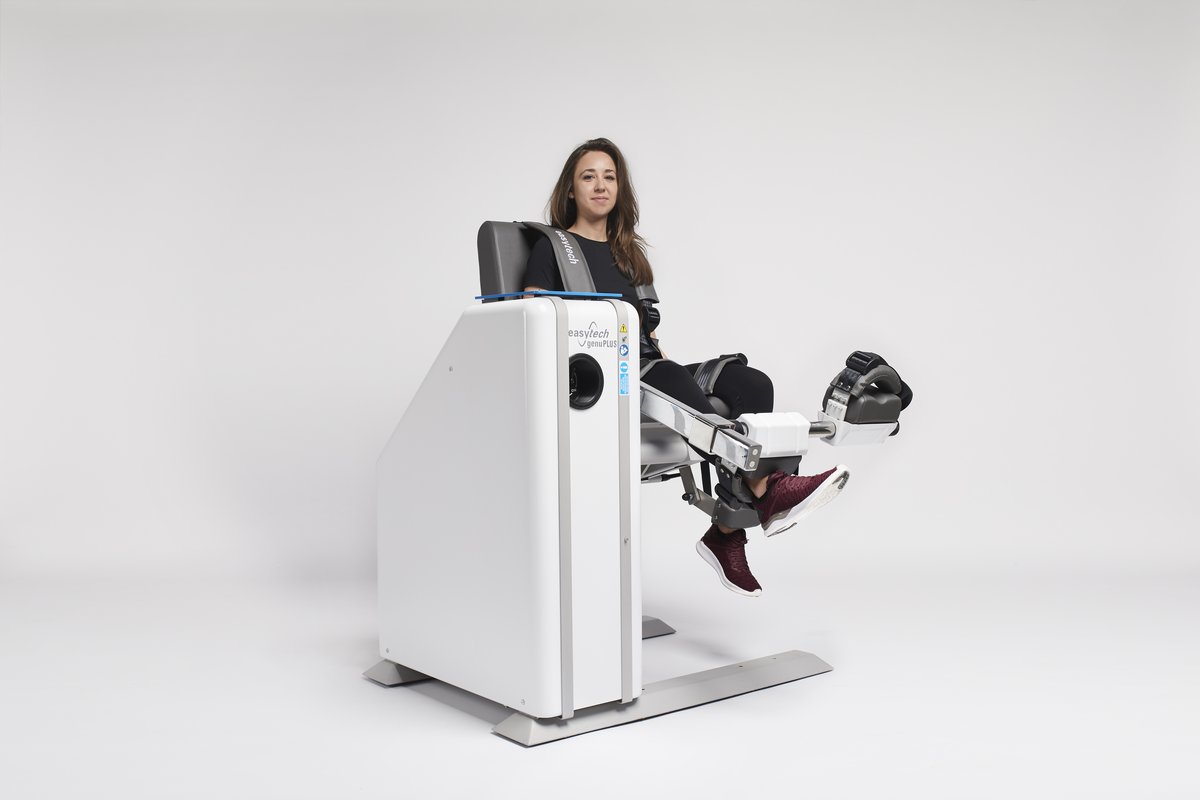
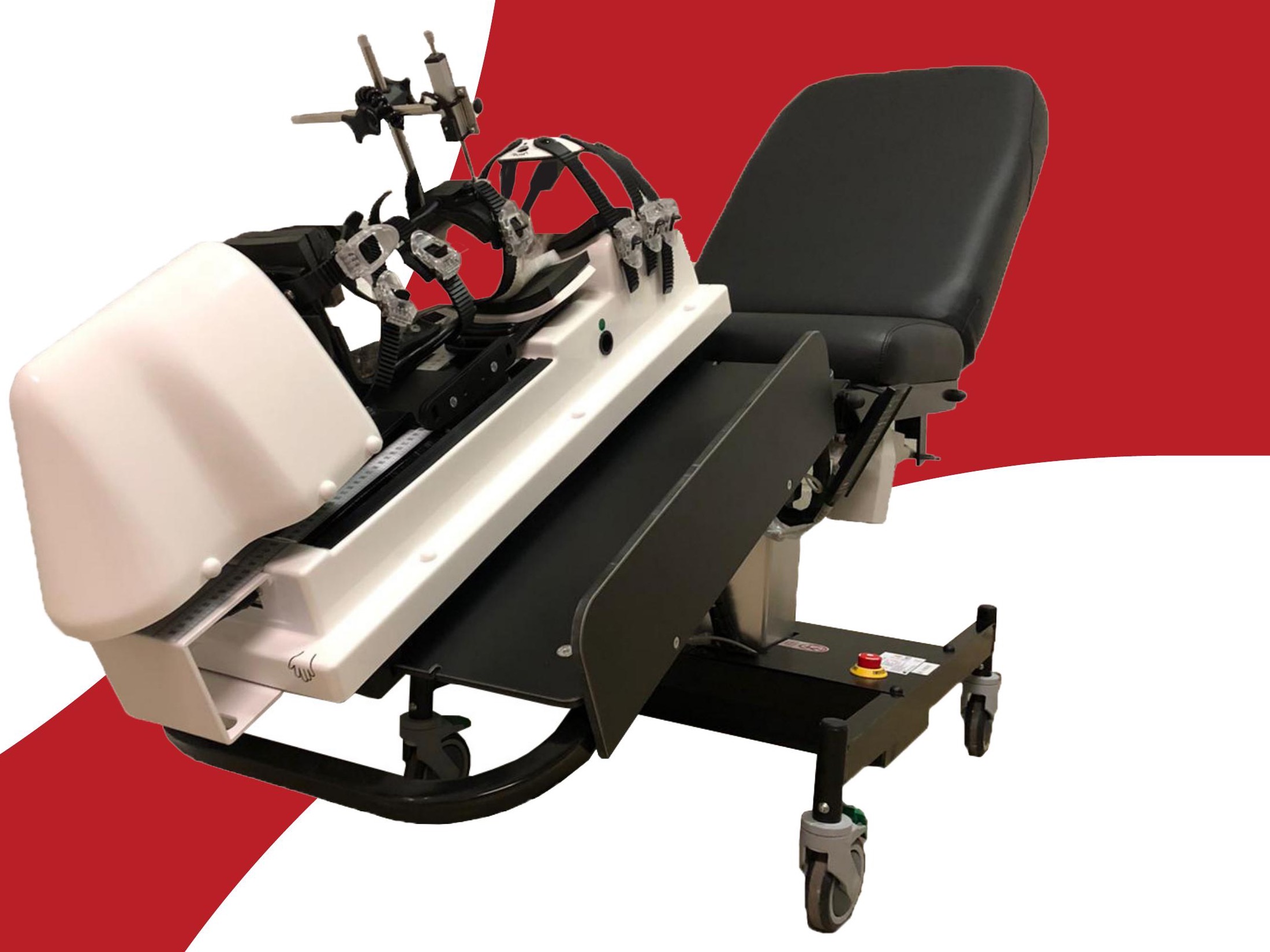
DYNEELAX® Dynamic Knee Laximetry Arthrometer
The world's only automated arthrometer that simultaneously measures both translation and rotation laxity of the knee — giving surgeons and sports medicine clinicians objective, reproducible data for ACL diagnosis, pre-operative planning, and return-to-sport clearance.
Download Brochure (PDF)Description
ACL injuries are among the most consequential in sport and active life — yet the tools most clinicians use to diagnose them remain inadequate. The Lachman test, anterior drawer, and pivot shift are examiner-dependent, qualitative, and impossible to compare across appointments or between clinicians. MRI — while invaluable for bony pathology — struggles profoundly with partial ACL tears, returning a sensitivity of just 29.5% in prospective studies validated against arthroscopy (Cojean et al., The Knee, 2023, n=214 patients).
DYNEELAX® changes this entirely. Developed by Genourob over 15 years of research and development, it is the world's only automated arthrometer that simultaneously quantifies both anterior tibial translation and tibial rotation — combining, in a single examination, assessments that previously required two separate devices (the GNRB® for translation and the ROTAM® for rotation).
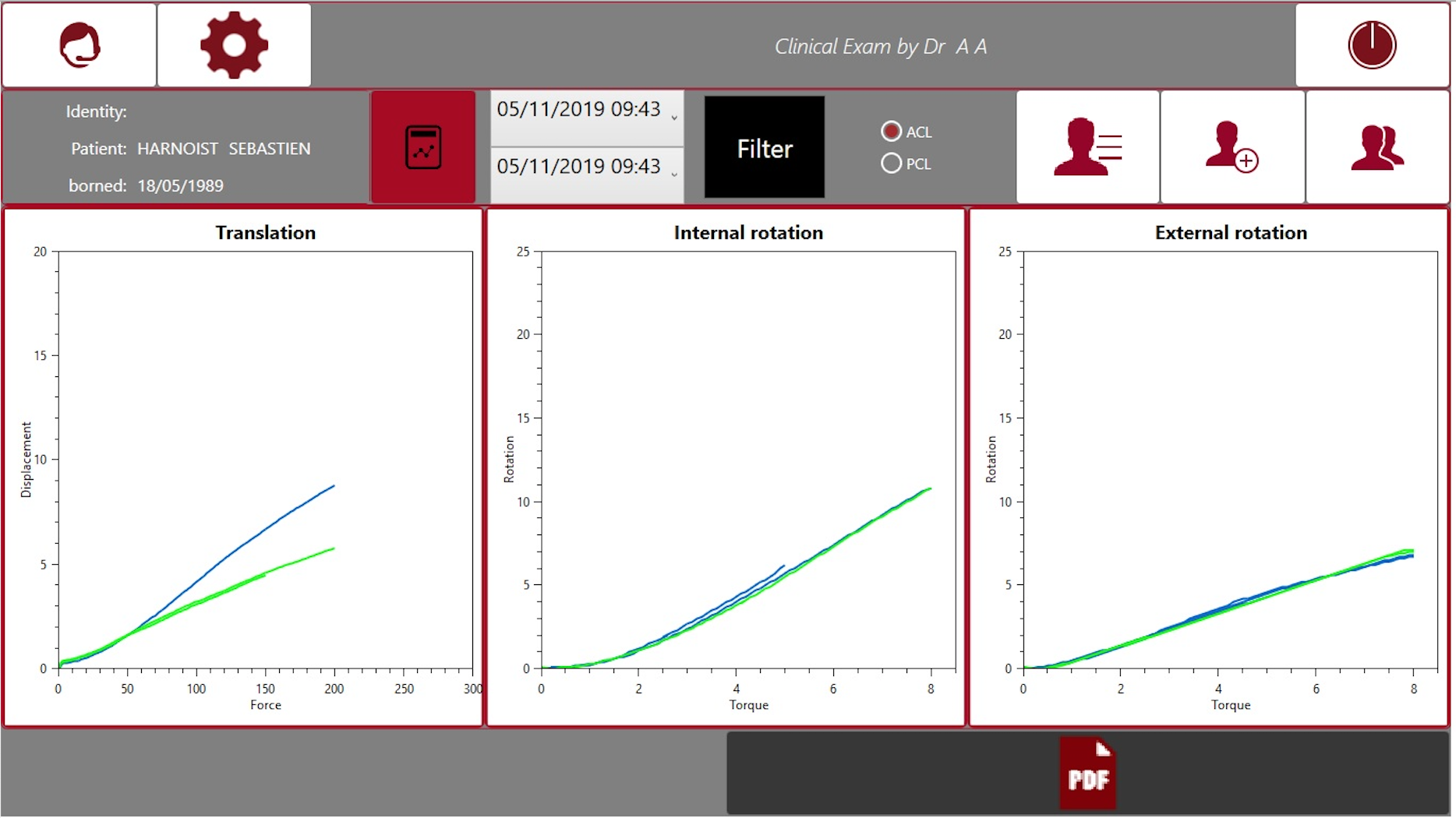
The system applies adjustable, precisely specified forces and torques to generate compliance curves for both axes. Critically, the analysis includes slope differentials (ΔP2) — the parameter that reveals not just ligament status, but the functional resistance of the ACL and peripheral stabilising structures. Two patients can have the same displacement differential yet entirely different functional outcomes; only DYNEELAX® detects this.
A 2024 reliability study at Aspetar Orthopaedic and Sports Medicine Hospital in Doha — 48 participants across healthy, ACL-injured, and ACL-reconstructed knees — demonstrated excellent intratest reliability across all metrics, with ICC values of 0.91–0.96. The minimum detectable change for anterior translation was just 0.83 mm (Nascimento et al., Translational Sports Medicine, 2024).
Leading Australian orthopaedic surgeons already rely on DYNEELAX® in practice. Dr Myles Coolican MBBS FRACS FAOrthA (The Knee Institute, Sydney) reports using it routinely before and after ACL reconstruction: 'We routinely utilise the Dyneelax for all of our patients both before reconstruction and at the twelve-month mark. This is an important part of our assessment to determine that the athletes are fit to return to pivoting sports.'
DYNEELAX® is trusted in over 50 countries for pre-operative diagnosis, post-operative graft monitoring, and objective return-to-sport clearance. All forces and torques are precisely pre-specified before each test — making it safe from Day 1 post-operatively. Results and patient positioning are automatically saved, enabling longitudinal tracking across the entire episode of care.
Clinical Endorsements
Trusted by leading orthopaedic surgeons and sports medicine specialists across Australia and internationally.
"We routinely utilise the Dyneelax for all of our patients both before reconstruction and at the twelve-month mark. This is an important part of our assessment to determine that the athletes are fit to return to pivoting sports. We found the Dyneelax extremely useful in demonstrating to patients that the symptomatic instability they complain of is mirrored with demonstrable abnormal kinematics. It is an extremely useful tool both in clinical practice and for research."
Dr Myles R J Coolican
MBBS FRACS FAOrthA — Orthopaedic Surgeon
The Knee Institute · Sydney Orthopaedic Research Institute
St Leonards, NSW, Australia
"Dyneelax has brought objective, reproducible data to the assessment of knee joint stability — something we have long needed in orthopaedic clinical practice and surgical education. I believe Dyneelax represents a major step forward in knee surgery — bridging the gap between subjective feel and measurable data."
Dr Sachin Tapasvi
MS(Orth) DNB(Orth) FRCS(Glasg) AFAOA — Chief Orthopaedic Surgeon
The Orthopaedic Speciality Clinic
Board Member ISAKOS · Past President, Indian Arthroscopy Society
"It is an excellent research tool which enables us to establish quantified measurement of the sagittal and rotational stability of multiple different knee arthroplasty devices — a measurement that heretofore was impossible. This is generating high level novel research of an international interest."
Assoc. Prof. Christopher Jones
FRACS FAOrthA PhD MBBS(Hons) — Orthopaedic Surgeon
Orthopaedics WA · Orthopaedic Research Foundation of Western Australia
Murdoch & Perth, WA, Australia
"Genourob allows me to quantify the stability of the operated knee. We systematically perform a test comparing both knees before the intervention and then at 6 weeks, 3 months and 6 months post-operative. I can also sometimes use a Genourob test in case of doubt about a possible re-rupture."
Dr Bruno Olory MD
Sports Orthopaedic Surgeon
Aspetar Orthopaedic and Sports Medicine Hospital
Doha, Qatar
Key Advantages
MRI Misses 7 in 10 Partial ACL Tears. DYNEELAX® Doesn't.
A prospective diagnostic study with arthroscopic validation on 214 patients (Cojean et al., The Knee, 2023) found MRI sensitivity for partial ACL tears was just 29.51% — while the GNRB®/DYNEELAX® technology achieved 73.77%. Partial tears are the most clinically difficult to diagnose and the most likely to be undertreated. DYNEELAX® detects them.
The Only Device Combining Translation AND Rotation in One Test
Before DYNEELAX®, assessing knee translation required the GNRB® and assessing rotation required the ROTAM® — two separate examinations. DYNEELAX® performs both simultaneously, generating translation and rotation compliance curves in a single, automated assessment. No other device in the world provides this combined analysis.
Excellent Reliability Validated at Elite Sports Medicine Centres
A 2024 study at Aspetar Orthopaedic and Sports Medicine Hospital, Doha (Nascimento et al.) — one of the world's leading sports medicine institutions — confirmed DYNEELAX® ICC values of 0.91–0.96 across all metrics. The minimum detectable change for anterior translation is 0.83 mm: a threshold precise enough for meaningful post-surgical monitoring.
Objective, Examiner-Independent Diagnosis
Clinical laxity testing is subjective and poorly reproducible — results vary between examiners, between sessions, and are difficult to document. DYNEELAX® eliminates this by automating the application of forces, standardising patient positioning via the LDA® Couch, and producing quantified compliance curves that can be reproduced at any visit, by any operator.
Trusted by Australian Orthopaedic Surgeons
Dr Myles Coolican MBBS FRACS FAOrthA (The Knee Institute, Sydney — Sydney Orthopaedic Research Institute) has used DYNEELAX® for two years: 'The addition of Dyneelax has helped assess rotation in a speedy fashion giving us more information on the stability achieved with ACL grafts... it is an extremely useful tool both in clinical practice and for research.'
Safe From Day 1 Post-Op — Used in 50+ Countries
All forces and torques are precisely specified by the clinician before each test begins — the device never applies more force than specified, making it safe for post-surgical monitoring from the early recovery phase. DYNEELAX® is trusted by surgeons, sports medicine physicians, and researchers across 50+ countries and backed by over a decade of peer-reviewed evidence.
Included & Optional Accessories
- LDA® Couch (included) — purpose-built examination couch with remotely adjustable angles for standardised DYNEELAX® positioning
- Knee Cup — standardises knee position and tightening force between both knees for optimal test-to-test comparability
- Foot Locker — secures the patient's foot in the device for accurate, reproducible testing
- Knee Locker — locks the patient's knee and records tightening values for session-to-session consistency
- Ruler — records device position before each test to ensure result comparability over time
- PCL Option Module — adds automated posterior tibial translation for PCL assessment (standard in DYNEELAX® PCL configuration)
Technical Specifications
| Test Method | LDA® (Automated Dynamic Laximetry) — automated Lachman test equivalent |
| Translation Measurement | Anterior tibial translation — forces up to 200 N (300 N maximum) |
| Translation Data Points | 50+ displacement values per test — full compliance curve with slope analysis |
| Rotation Measurement | Internal and external tibial rotation — adjustable torques, chosen before each test |
| Sensors | Precision goniometer (rotation) + displacement sensor (translation) |
| Slope Analysis | ΔP2 differential of slopes — detects functional instability even when displacement Δ134 is similar |
| Included Couch | LDA® Couch — designed specifically for DYNEELAX, remotely adjustable angles for standardised positioning |
| Software | User-guided interface — graphs, tables, compliance curves, automated export |
| Data Storage | Automatic — saves patient results and device positions for longitudinal comparison |
| Safety | All forces and torques pre-specified before each test — safe pre-op and post-op |
| PCL Option | Posterior tibial translation module available — see DYNEELAX® PCL |
| Countries in Use | 50+ worldwide |
| R&D History | Successor to GNRB® (translation) and ROTAM® (rotation) — 15+ years development |
| Certification | CE Medical Device |
Related Products
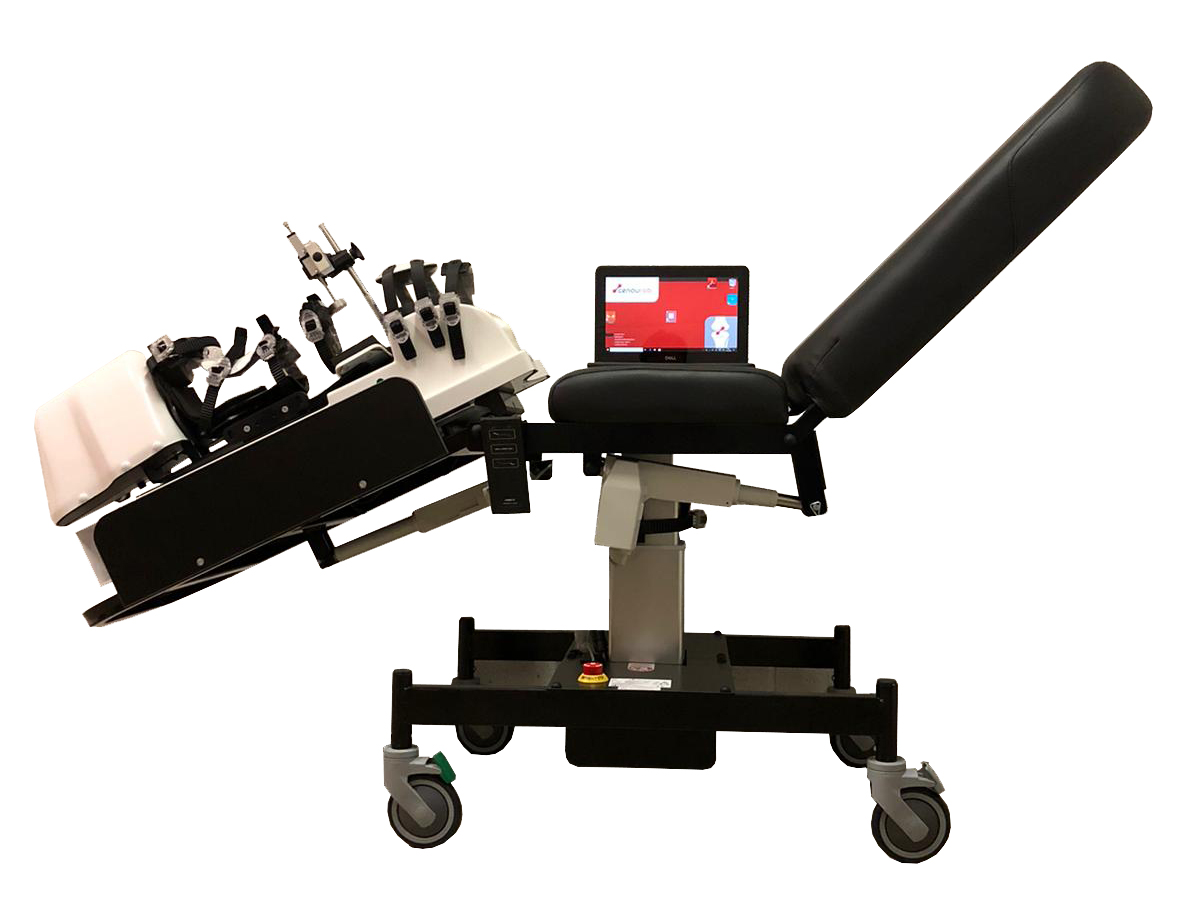
DYNEELAX® PCL — Complete Knee Ligament Assessment
View Details
HUMAC NORM Isokinetic Dynamometer
View Details